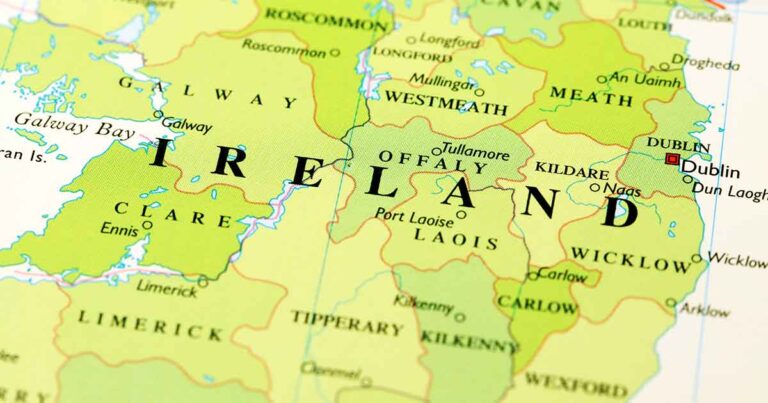

Average Salary in Ireland in 2026 – An Ultimate Guide
This article covers:
- Overview: Key Points
- Do You Know?
- Ireland salary trends: Factors affecting salary in Ireland
- Avg salary for full-time workers in Ireland: (€3,683/month or €44,196/year)
- Avg salary for part-time workers in Ireland: (€15.14 per hour & €2,461 per month)
- The average salary in Ireland: Citywise
- Highest paying jobs in Ireland
- Lowest/minimum paying jobs in Ireland
- Salary for experience
- Difference between median & average (mean) Salary
- Before You Go…
- FAQs
The average full-time salary in Ireland is €3,683/month or €44,196/year. For part-time, it’s €15.14/hr or €2,461/month.
According to KPMG’s 2026 Economic Outlook, Ireland is expected to be one of the top five fastest-growing economies in Europe. GDP growth is projected at around 3%, alongside 2.5% growth in Modified Domestic Demand (MDD), supported by strong demand, steady job creation and strategic government investment.
Whether you’re an expat seeking a job in Ireland or a local trying to make a career switch, you must know what the basic salary in Ireland is to set your expectations right. This blog educates you on the factors affecting salaries and provides insights into Ireland’s salary comparison.
Overview: Key Points
- Ireland’s average income for a full-time worker is €3,683/month and €44,202/year.
- A part-time employee can earn a €15.14/hr salary in Ireland. The average median income for a part-time worker is €2,461/month.
- The fastest-growing industries in Ireland are:
- Healthcare, Pharmaceutical & Social Services (avg annual salary: €58,959)
- Legal (avg annual salary: €54,099)
- Engineering (avg annual salary: €50,538)
- The top recruiters in Ireland are Accenture, IBM, Apple, Intel, Pfizer, AstraZeneca, Deloitte, Fidelity Investments, HubSpot, Johnson & Johnson, Dell Technologies, etc.
Do You Know?
- Ireland’s employment rate was 79.9% in 2025 Q3, marking a well-performing labour market [1]
- In IMD’s World Competitiveness Survey 2025, Ireland ranked in the top ten among 64 economies measured for their global competitiveness. The factors taken into consideration included infrastructure, business efficiency, government efficiency, and economic performance. [2]
- With an average annual income of USD 80,650, Ireland ranks 9th for the highest average income in the world. [3]
- The National Minimum Wage Act has set the minimum wage to €14.15 per hour effective from 1st January 2026. [4]
Ireland salary trends: Factors affecting salary in Ireland
- Industry – The salary you earn in the growing industries of Ireland is higher than the salary disbursed in other industries. For example, a General Manager in an engineering company will earn more than a General Manager at a restaurant.
- Level of Education – There is also a difference in salary by education level. Those with a high level of education earn more than those with a Bachelor’s Degree.
- Work Experience – As you gain experience, you expand your network, improve strategic vision, and enhance leadership qualities. That will make you an asset for companies, resulting in higher salaries. So, the more work experience, the higher the salary.
- Job roles and responsibilities – Your job position also plays a role in determining your salary. A higher position like senior executive, director, or president means more responsibilities and higher salaries.
- Location – Your salary may also vary depending on the work location. For instance, the salaries in Dublin, Limerick, and Cork are higher than in other cities.
- Company’s profitability and standing in the market – A company’s position and background affect its revenue, which, in turn, affects the salaries it pays.. If you work with a global brand, you’ll earn much more than you would earn with a new company.
- Economic conditions – The unemployment rate, inflation, interest and exchange rates, cost of living, and demand and supply, among others, are economic factors affecting salaries.
- Government regulations – The government’s employment regulations and labour laws also impact the potential salary in Ireland.
- Global influence – A country’s contribution and position in the global landscape affect the dynamics of the labour market. Thus, Ireland’s world competitiveness also affects the basic salary of professionals.
Also Read: Visiting Ireland? Over 80 slangs & phrases you might want to know
Avg salary for full-time workers in Ireland: (€3,683/month or €44,196/year)
Ireland is geared for dynamic growth across industries, with engineering, technology, life sciences, marketing, financial services, and accountancy leading the charge. Many international students, as well as experienced professionals, are keen to pursue a career in this European country. If you’re one of them, you should have adequate information about the pay scale in Ireland for different industries.
The following table shares the salary data in Ireland for the top seven industries to help you make wise decisions and embark on a professional journey according to your financial goals.
| Top Industries | Average Annual Salary (in EUR) |
| Healthcare, Pharmaceutical & Social Services | €58,959 |
| Legal | €54,099 |
| Sciences | €54,056 |
| Information Technology | €52,464 |
| Engineering | €50,538 |
| Marketing & Sales | €42,683 |
| Construction & Maintenance | €48,449 |
Source: Talent
Below are some of the top job profiles in each of these top 5 industries.
Healthcare, pharmaceutical & social services: Average annual salary – €58,959
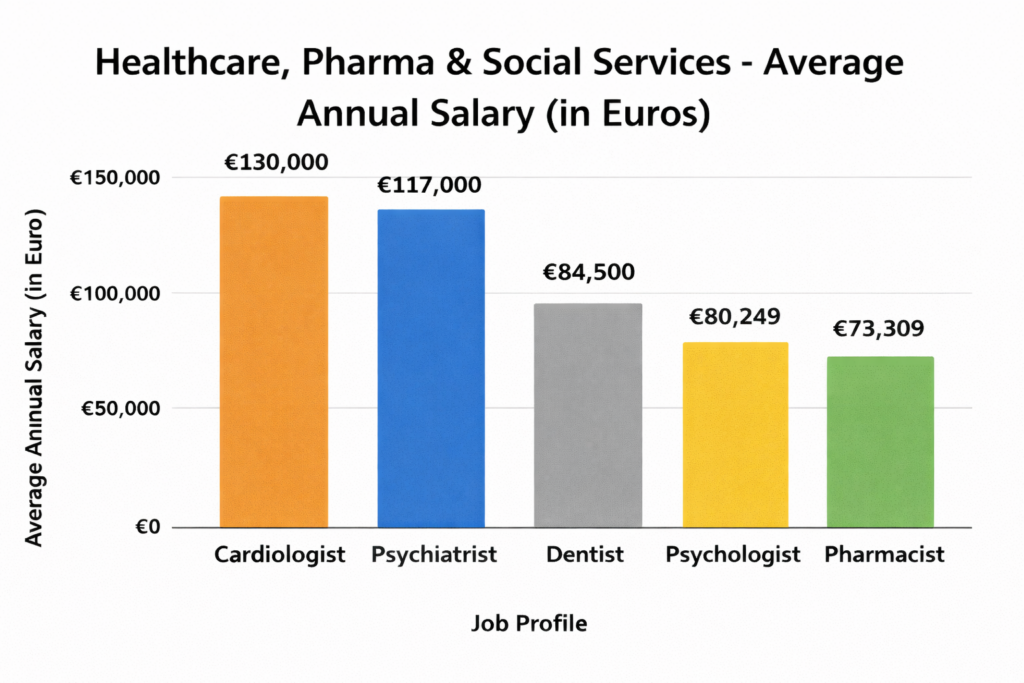
Source: Talent
Legal: Average annual salary – €54,099
Mediator: €67,705
Lawyer: €67,500
Paralegal: €34,190
Source: Talent
Sciences: Average annual salary – €54,056
Geologist: €80,000
Physicist: €65,280
Data Scientist: €50,000
Biologist: €40,000
Lab Technician: €35,000
Source: Talent
Information Technology: Average annual salary – €52,464
Database Analyst: €81,120
Network Administrator: €65,000
Back-End Developer: €51,260
Front-End Developer: €51,260
System Administrator: €47,500
Source: Talent
Engineering: Average annual salary – €50,538
Software Engineer: €59,000
Project Engineer: €59,000
Electrical Engineer: €49,000
Biomedical Engineer: €49,000
System Engineer: €49,000
Source: Talent
Avg salary for part-time workers in Ireland: (€15.14 per hour & €2,461 per month)
Individuals in Ireland can work part-time, and their rights are protected under the Protection of Employees (Part-Time Work) Act 2001.
Moreover, international students can also undertake part-time working opportunities along with their academics. This helps them to cover the costs of living in Ireland while pursuing their higher education. There are many rules and regulations governing part-time jobs in Ireland. Students pursuing a course for a year or more don’t need a special work permit to take up these jobs. However, students must have a Garda National Immigration Bureau (GNIB) registration. They should also have enrolled in a program recognised by the Minister for Education and Skills.
The table below highlights the average per-hour salary in Ireland for part-time jobs.
| Type of Job | Average Pay Per Hour (in EUR) |
| Sales Assistant | €21 |
| Tutor | €25 |
| Library Assistant | €16 |
| Community Support Worker | €24 |
| Driver Helper | €15 |
As of 2026, you can earn €14.15 per hour as the minimum average wage in Ireland. Apart from the part-time jobs listed above, there are many other job types in Ireland in the following sectors:
- Bars/Restaurants/Cafes
- Entertainment
- Call Center
- Retail
- Secretary
Also read: 10 highest paying part-time jobs for students in Ireland 2024
The average salary in Ireland: Citywise
The average income in Ireland varies from city to city. Most international and renowned organisations have offices in Dublin, the capital of Ireland. The cost of living in Dublin is relatively higher due to the advanced infrastructure. As a result, the salary is also higher.
In the table below, you can see Ireland’s salary comparison between cities.
| City | Average Annual Salary (in EUR) |
| Dublin | €54,131 |
| Limerick | €47,321 |
| Cork | €48,567 |
| Galway | €47,469 |
| Waterford | €39,000 |
Source: Salary Expert and Payscale
Highest paying jobs in Ireland
Ireland’s current labour market is robust, with unemployment rates at historic lows and a high participation rate. There is also scope for significant wage growth, especially in sectors suffering from skill shortages like engineering, financial services, and technology.
Like most countries, Ireland offers higher salaries to people with specialised skills, high education levels, and work experience. These professionals have achieved senior-level roles, such as C-level executives, presidents/vice presidents, directors, etc., and possess strong leadership qualities.
If you want to earn a high salary in Ireland, check out this table highlighting the country’s highest-paying jobs.
| Job Title | Industry | Average Annual Salary (in EUR) |
| Chief Executive | Banking & Financial Services | €300k – €500k |
| Chief Executive Officer | Banking & Financial Services | €160k – €450k |
| Chief Financial Officer | Accounting & Finance | €180 – €400k |
| R&D Director | Life Sciences & Engineering Recruitment | €250k – €350k |
| Chief Operating Officer | Banking & Financial Services | €140k – €350k |
| Chief Risk Officer | Legal, Risk & Compliance | €220k – €350k |
| Chief Information Officer | Technology | €200k – €350k |
| Chief Actuary | Banking & Financial Services | €140k – €320k |
| International General Counsel | Legal, Risk & Compliance | €250k – €300k |
| Chief Technology Officer | Technology | €200k – €300k |
Source: Morgan Mckinley
Must Read: Best countries to migrate from India
Lowest/minimum paying jobs in Ireland
Some jobs in Ireland offer a low pay package. These jobs belong to the services sector or are entry-level roles, such as cleaners, assistants, packers, postal workers, cashiers, porters, etc. You can pursue these jobs without any skills or qualifications.
Ireland’s labour regulations promise a €14.15 per hour wage, making it possible for you to earn over €1,000 even in menial jobs. The lowest-paying job roles and positions are listed in the following table.
| Job Types | Industry | Average Monthly Salary(in EUR) |
| Nursery Teacher Assistant | Education | €1,690 |
| Social Counselor | Medicine & Social Care | €1,785 |
| Tailor | Textile Industry | €1,824 |
| Cleaner | General Labour | €1,824 |
| Packer | Production | €1,966 |
Source: Paylab
Salary for experience
The most essential factor in determining your salary after your educational qualification and specific profession is the number of years of work experience. Employers across the globe prefer to hire candidates with relevant work experience, and Ireland is no different.
The variation in salary based on experience is evident in the pay structure of employees working in Ireland. The following table shows how the average income in Ireland continues to increase with an increase in the years of work experience.
| Years of Work Experience (in years) | Average Salary Per Year (in EUR) |
| 0 – 1 (interns or fresh graduates) | €39,024 |
| 1 – 2 | €40,745 |
| 2 – 4 | €45,091 |
| 4 – 8 | €54,779 |
| 8 – 12 | €65,011 |
| 12 – 16 | €69,629 |
| 16 – 20 | €79,226 |
| 20+ | €85,383 |
Source: Average Salary Survey
Difference between median & average (mean) Salary
If you search for the average salary in Ireland, you’ll often come across the term ‘median salary.’ Often, the terms ‘mean’ and ‘median’ salaries are used interchangeably. However, they are quite different.
Let us understand the calculation of the two with the following example. The table lists the annual salary of five different individuals.
| Person 1 | €10,000 |
| Person 2 | €22,000 |
| Person 3 | €50,000 |
| Person 4 | €75,000 |
| Person 5 | €38,000 |
To estimate the average income in Ireland using the mean method, you add all the salaries and divide the total by the number of persons.
(10000 + 22000 + 50000 + 75000 + 38000) / 5 = €39,000
The average salary in the above example is €39,000.
Now, to estimate the average median salary, you rearrange the salary figures in ascending order, as follows:
- 10,000
- 22,000
- 38,000
- 50,000
- 75,000
The middle value in the distribution of salaries, which is €38,000, is the median salary. Factually, Ireland’s average income is €38,600 per year, and Ireland’s median income is €36,800 per year.
You can use the median and average salary to gauge how well you are being paid compared to the overall population.
- A salary higher than the average and median salary indicates that you are doing well compared to others.
- A salary lower than the average and median salary indicates that you need to work harder and enhance your skills to increase your salary.
- A salary between the average and median salary is tricky. You need to research more closely and understand the growth and other aspects affecting your salary.
Before You Go…
You can apply for a myriad of job opportunities in Ireland across diverse fields and disciplines. A welcoming environment in the thriving finance, healthcare, and tech sectors, among others, makes Ireland an attractive destination for foreign professionals.
If you’re interested in working in Ireland, you can make an informed decision after reading through the salary data in Ireland. You can understand which sector, job position, and company are the best for you.
Once you settle and start earning an income in Ireland, you can use Instarem, a renowned and trusted platform for international money transfers. It is popular and convenient for sending money to India because of its affordable, secure and fast transaction methods.
Try Instarem for your next transfer.
Download the app or sign up here.
The other benefits that make Instarem an attractive option for overseas transactions are no hidden charges, a network of fund transfer facilities available in over 60 countries, and exciting rewards on every transaction.
FAQs
Q. What is the current average salary in Ireland?
Jobted estimates Ireland’s current average yearly salary to be €44,202, which translates to €3,683 per month.
Q. What is a good salary in Ireland?
A gross salary, ranging between €4,100 and €6,000 per month, is presumed to be good for living a comfortable life in Ireland. But you must know that the meaning of ‘good’ differs from person to person. Hence, a good salary will depend on the individual’s living circumstances and lifestyle, requirements, and financial goals.
Q. Which job has the highest salary in Ireland?
The highest-salary jobs in Ireland belong to the healthcare, legal, engineering, life sciences, and IT industries. You need to advance to C-level executive, directorial, and senior management positions to receive a higher salary.
Q. Which job has the lowest salary in Ireland?
Freshers or those with little to no educational qualifications receive a low salary. Some job types with the lowest salary in Ireland include cleaners, packers, tailors, porters, assistants, postal workers, etc.
Q. What is the average salary in Ireland for IT?
The average salary for an IT professional working in Ireland is €52,464 per year.
Q. What is the average salary in Ireland per month for an Indian?
The average salary in Ireland per month for an Indian varies based on factors like industry, experience, job role, and location. Professionals can expect to earn a salary anywhere between €30,000 and €150,000 per year.
Q. How do you find a job in Ireland?
You can avail of the services of recruiting agencies or online job portals to find a job in Ireland. These platforms help you connect with potential employers and give you an insight into the opportunities available in the job market. You can also get their assistance to curate a good resume.
Other related blogs:
Germany – Average Salary in Germany
Australia – Average Salary in Australia
USA – Average Salary in USA
Canada – Average Salary in Canada
UK – Average Salary in UK
Disclaimers:
This article is intended for informational purposes only. All details are accurate at the time of publishing. Instarem has no affiliation or relationship with the products or vendors mentioned.
* Fast meaning 75% of our transactions are completed in 15 minutes. Depending on the funding method.
#When it comes to affordable exchange rates and fees, it’s worth noting that the cost will vary depending on how you choose to fund your Digital transactions. Credit card funding and bank transfer fees can differ significantly.
Citations:
- [1]https://enterprise.gov.ie/en/news-and-events/department-news/2026/january/20260104.html#:~:text=Relative%20to%20the%20EU%2C%20Ireland,and%2076.2%25%20in%20the%20EU.
- [2]https://www.imd.org/centers/wcc/world-competitiveness-center/rankings/world-competitiveness-ranking/
- [3]https://www.worlddata.info/average-income.php
- [4]https://www.workplacerelations.ie/en/what_you_should_know/hours-and-wages/national%20minimum%20wage/