



Cost of living in Spain – Single, family & student

This article covers:
- Do you know?
- A glance at the average cost of living in Spain
- Average cost of living in Spain: Single vs student vs family
- Tax scenario
- Health insurance in Spain
- Entertainment
- Other costs to know about
- Big Supermarket Chains (your weekly go-to)
- Local Markets (Mercados) – the real experience
- Specialty Shops
- Convenience Stores & Mini-marts
- Transport in Spain
- What average salary do you need to live in Spain?
- What should be your monthly budget to live in Spain?
- Do’s & don’ts
- Best places to live in Spain for students and job seekers
- Before you go…
The monthly cost of living in Spain is:
Single person: € 1422 (with rent), € 612 (excluding rent)
Student: € 1100 (with rent).
Family of four: € 3220 (with rent), € 1907 (excluding rent)
With its affordable cost of living, Spain offers a unique blend of culture and opportunity that appeals to both students and professionals alike. This guide provides a financial overview of relocating to Spain, including a detailed breakdown of Spain’s cost of living index. This information will help you plan your relocation efficiently and make informed decisions about your budget and lifestyle.
So, when you think of Spain, what comes to mind? Sunny climate, amazing paella, and super welcoming people, right?
Well, the cost of living is actually pretty affordable for international living, too. Spain offers a good mix of culture and opportunity is exactly what draws so many students and professionals.
This guide gives you a friendly, down-to-earth look at what it’s like to relocate to Spain. We’ll walk you through which cities are more expensive (and which are more budget-friendly), and how Spain stacks up against other European countries. Basically, think of it as a clear breakdown of the cost of living, so you can plan your budget and lifestyle without the stress.
Do you know?
The unemployment rate in Spain decreased from 10.4% in 2025. [1]
Spain’s inflation rate significantly decreased from 8.4% in 2022 to 2.3% in 2026. [2]
The GDP per capita of Spain increased from USD 29,674.5 in 2022 to USD 38,040 in 2025.[3]
A glance at the average cost of living in Spain
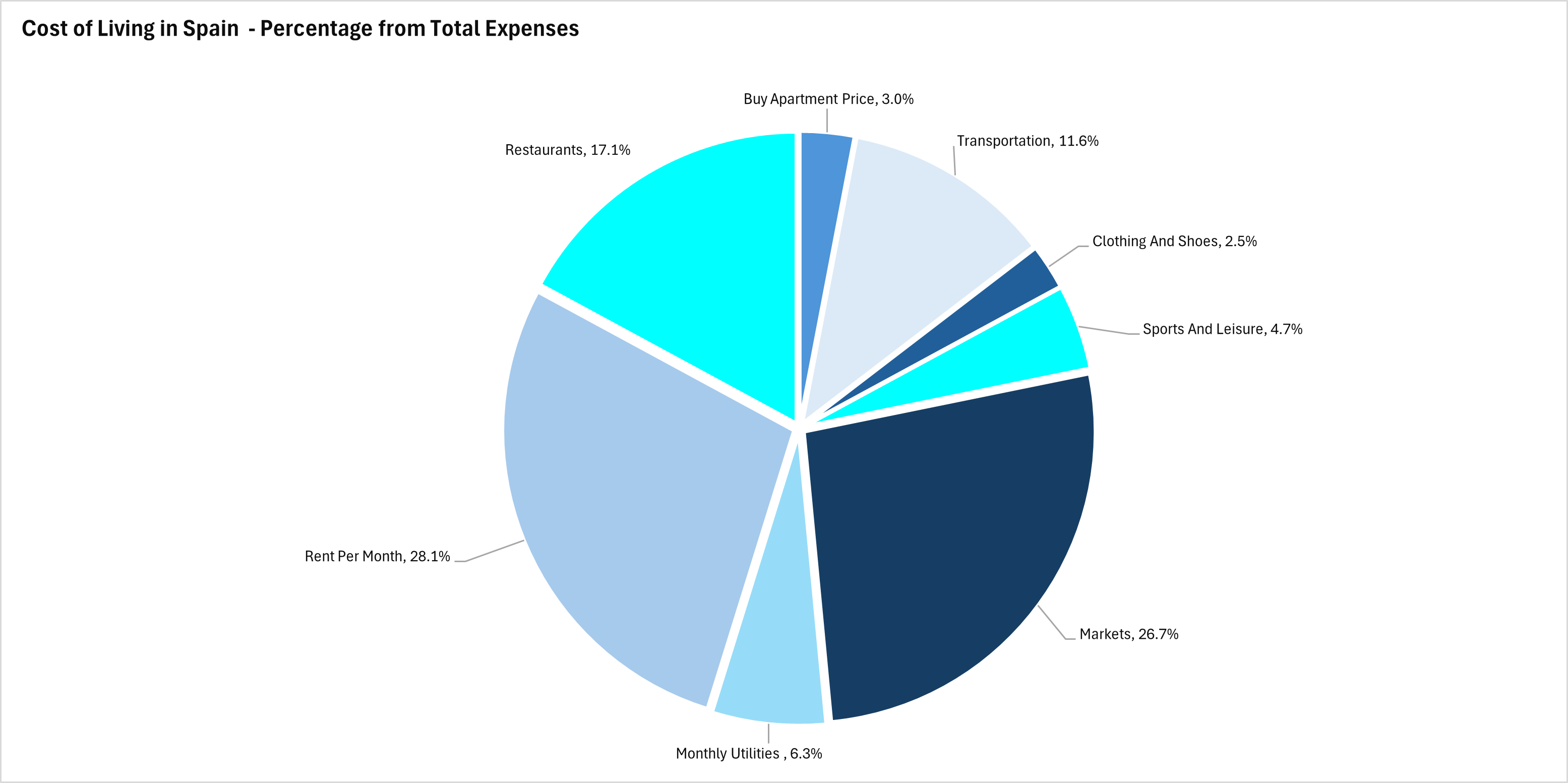
Expense Category | Percentage from Total Expenses |
Buy Apartment Price | 3% |
Transportation | 11.6% |
Clothing And Shoes | 2.5% |
Sports And Leisure | 4.7% |
Markets | 26.7% |
Monthly Utilities | 6.3% |
Rent Per Month | 28.1% |
Restaurants | 17.1% |
Source: Numbeo
Average cost of living in Spain: Single vs student vs family
Type of expense | Avg. cost per month for student | Avg. cost per month for singles | Avg. cost per month for family |
Rent and Utilities (electricity, water, heating, etc. ) | € 620 | € 717 | € 1153 |
Food/groceries | € 300 | € 364 | € 966 |
Transportation | € 54 | € 80.4 | € 223 |
Source: Livingcost.org, Mastersportal.
An overview of monthly rents in Spain
To give you a better idea of what living in Spain might cost, here’s a quick overview of average rental prices across the country — from smaller towns and quieter cities to major hotspots like Madrid and Barcelona.
Expense Category | Item | Avg. cost per month |
Housing | 1-bedroom apartment (in the city centre) | € 958.61 |
1-bedroom apartment (outside the city centre) | € 715.95 | |
3-bedroom apartment (in the city centre) | € 1,501.39 | |
3-bedroom apartment (outside the city centre) | € 1,058.19 |
Source: Numbeo
Average living cost in Spain: Citywise
Type of expense | Madrid | Barcelona | Valencia | Seville |
Average Monthly Salary (after taxes) | € 2174 | € 1978 | € 2020 | € 1509 |
Cost of living (single) | € 1589 | € 1632 | € 1323 | € 1187 |
Cost of living (family) | € 3668 | € 3761 | € 2996 | € 2617 |
Rent & utilities (single) | € 908 | € 956 | € 745 | € 634 |
Rent & utilities (family) | € 1558 | € 1638 | € 1168 | € 971 |
Food (single) | € 405 | € 404 | € 375 | € 364 |
Food (family) | € 1083 | € 1071 | € 1012 | € 960 |
Transport (single) | € 154 | € 151 | € 91.2 | € 81.7 |
Transport (family) | € 421 | € 424 | € 254 | € 224 |
The overall quality of life | 90 | 88 | 84 | 80 |
Source: Livingcost.org (Refer to citiwise cost of living pages)
Tax scenario
Non-resident individuals in Spain are liable to pay Spanish non-residents’ income tax (NRIT). They are generally subject to income tax on earnings derived from sources within Spanish territory. This includes income from economic activities, employment, pensions, capital gains and real estate. The specific tax rules and exemptions vary depending on the type of income and the circumstances of the individual.
If the income is not obtained through a permanent establishment (PE), it cannot be offset against gains. However, no reductions are applicable for taxable incomes without a PE. It is important to note that specific tax exemptions and deductions may apply.
Consulting a tax professional is recommended to ensure compliance with Spanish tax laws and optimise tax planning.
Source: Sede.agenciatributaria, Tax Summaries PwC – Spain
Health insurance in Spain
Aside from all the excitement (and chaos) of moving to a new country, one thing you’ll definitely want to sort out early is healthcare. Nobody plans to get sick, but it’s always better to understand how Spain’s healthcare system works before you actually need it.
Here are the three main ways most expats handle their healthcare needs in Spain.
1. Public Healthcare System (SNS)
Spain’s public healthcare system is called the Sistema Nacional de Salud (SNS), and it’s one of the reasons many people love living there. It generally covers GP visits, specialist care, hospital treatment, emergency services, and even some subsidised medication.
If you’re a Spanish resident, working and contributing to social security, or an EU citizen, you’ll likely be able to access the system. So yes, if you’re planning to move to Spain long-term, this is definitely an option worth considering.
That said, there are a few things to keep in mind. Waiting times can sometimes be quite long, especially for specialist appointments. And certain services like dental care and vision may not be fully covered.
2. Private Healthcare
Of course, sometimes you just want faster access and more flexibility. That’s where private healthcare comes in.
If you need urgent care or simply don’t want to wait weeks for an appointment, private healthcare can be a great alternative. One big advantage for expats is that it’s often easier to find English-speaking doctors, which makes life much less stressful if your Spanish isn’t fluent yet.
You’ll also usually get access to a wider choice of hospitals and specialists without needing referrals first.
Costs typically range from around €50–€200 per month, depending on your age, level of coverage, and any additional benefits you choose.
Some of the major providers in Spain include Sanitas, Adeslas, and Mapfre.
Entertainment
One thing you definitely won’t run out of in Spain is entertainment. There’s always something happening, whether it’s festivals, food, music, or cultural events.
And if you’re looking for budget-friendly activities, museums are a great option. Many museums across Spain offer free entry days, so it’s worth checking schedules before you visit. It’s an easy way to explore the culture without spending too much.
Other costs to know about
Living in Spain as an expat can also come with a few hidden costs – the kind of things you may not immediately think about when planning your move.
Gastos de comunidad
This basically refers to community or building maintenance fees – similar to condo or service fees.
In bigger cities like Madrid or Barcelona, many apartment buildings charge around €50 – €150 per month for shared upkeep such as elevators, stairways, gardening, pools, and general maintenance.
It’s one of those monthly expenses that can sneak up on you if you don’t budget for it early.
NIE (Foreigner ID Number)
If you’re moving to Spain, getting an NIE number is pretty much unavoidable. You’ll need it for things like signing leases, opening a bank account, or even getting a mobile plan.
The application itself usually costs around €10 – €15, although some people also pay additional lawyer or agent fees if they want help with the paperwork.
Banking fees
Not all Spanish bank accounts are free. Some banks charge monthly maintenance fees of around €5 –€15 unless you meet certain conditions, like depositing your salary or maintaining a minimum balance.
So before opening an account, it’s worth checking the fine print to avoid unexpected charges later on.
Translations and notarisation
This is another expense many expats don’t think about at first.
If your official documents aren’t already in Spanish, there’s a good chance you’ll need certified translations or notarised copies for visas, applications, or registrations. These translations can cost around €20 – €40 per page, so the fees can add up quite quickly depending on how many documents you need.
Big Supermarket Chains (your weekly go-to)
Mercadona
Most people in Spain will probably tell you the same thing. If you want a reliable supermarket for everyday groceries, Mercadona is the go-to.
You can find pretty much everything there, from fresh produce and meats to household essentials, and the prices are generally reasonable too. It’s one of those places you’ll probably end up visiting more often than you expect. Plus, they also offer home delivery if you’d rather shop online.
Carrefour
If you love having lots of options in one place, Carrefour might become your favourite.
It’s huge. Besides groceries, you’ll also find electronics, clothes, home items, and more. Think of it as a supermarket-meets-department-store situation. So if you’re someone who likes getting everything done in one trip, Carrefour is super convenient.
DIA
DIA is a more budget-friendly option and works well if you’re trying to keep your grocery spending low.
The stores are usually smaller, and the selection may not be as extensive, but if you’re after basic essentials without spending too much, it does the job perfectly fine.
Other popular supermarket chains you’ll come across include Lidl, Aldi, and Eroski.
Local Markets (Mercados) – the real experience
One thing you’ll quickly notice in Spain is how much people love their local markets.
These markets are where many locals go for fresh fruits, vegetables, seafood, meats, and artisanal products. And honestly, the quality can be really good. In some cases, prices may even be cheaper than those in supermarkets, especially if you know where to look.
If you enjoy cooking or simply want a more authentic experience, visiting a local mercado is definitely something worth doing.
Specialty Shops
Spain also has plenty of speciality stores, which can be really useful depending on what you need.
For example, if you want fresh bread, you’ll usually head to a bakery (panadería). Need quality meat? There are butcher shops for that. Want seafood? Fishmongers are common too.
Instead of buying everything from one supermarket, many locals still shop at different speciality stores for specific items.
Convenience Stores & Mini-marts
And then there are the convenience stores, the lifesavers for late-night cravings or emergency snack runs.
They’re usually smaller, open for longer hours, and easy to find around cities. The downside is that prices are often slightly higher compared to supermarkets, but sometimes convenience wins, especially when you just need something quickly.
Transport in Spain
Depending on which part of Spain you’re living in, you’ll usually rely on either public transport or local transport options to get around.
And if you plan to travel around the country often, it’s worth looking into monthly transport passes. They can save you quite a bit of money. In some regions, monthly passes can cost around €60, but if you’re under 26, you may even find options for as low as €30 for public transport.
Here are some of the main transport options available in Spain.
Trains (fast, comfortable, and popular)
Spain’s rail system is honestly one of the easiest ways to travel around the country. The high-speed train network, AVE, connects major cities like Madrid, Barcelona, Seville, and Valencia.
The trains are fast, comfortable, and usually much more relaxing than dealing with airport queues. Plus, if you book tickets early, you can sometimes find pretty decent deals too.
Buses (cheaper, with wider coverage)
If you’re looking for a more budget-friendly option, buses are everywhere in Spain.
Long-distance buses are especially useful if you’re travelling to smaller towns or places where trains don’t reach as easily. The journey may take longer compared to the AVE, but buses can be surprisingly comfortable and much cheaper.
Domestic flights (best for islands or long distances)
Spain is big enough that sometimes flying just makes more sense — especially if you’re heading to the islands.
If you’re travelling between mainland Spain and places like the Balearic Islands or the Canary Islands, domestic flights are usually the fastest and most practical option. Airlines like Iberia and Vueling are commonly used for these routes.
Metro (city transport made easy)
If you’re living in a major city, chances are you’ll end up using the metro a lot.
Cities like Madrid and Barcelona have extensive metro systems that are easy to navigate, reliable, and relatively affordable. If you’re used to systems like the MRT in Singapore, you’ll probably adapt quite quickly.
Taxis & ride-hailing apps
And of course, there’s always the option of taxis and ride-hailing apps when convenience matters most.
If you don’t feel like figuring out directions in Spanish or simply want a direct ride home, apps like Uber and Cabify are available in many cities. They’re especially useful for late nights, airport runs, or when you’re carrying luggage around.
What average salary do you need to live in Spain?
The salary needed to live comfortably in Spain varies widely depending on lifestyle, location, and expenses.
Spain’s standard of living is generally considered affordable compared to other European countries. However, the cost of living in Spain is 1.32 times higher than the world average. A salary that comfortably covers your expenses and lifestyle is a good benchmark for living comfortably in Spain.
Also read: 5 salary negotiation tips that will get you paid what you’re worth.
What should be your monthly budget to live in Spain?
As they say, all work and no play makes Jack a dull boy. So beyond just rent, it’s important to budget for everyday living too.
From groceries and dining out to utilities, entertainment, public transport, and other day-to-day expenses, here’s a breakdown of the common monthly costs you can expect while living in Spain.
Category | Student | Single | Family |
Rent and Utilities (electricity, water, heating, etc. ) | € 450 – € 950 | € 500 – € 900 | € 800 – € 1300 |
Groceries | € 150 – € 500 | € 200 – € 550 | € 700 – € 1200 |
Transportation | € 30 – € 70 | € 60 – € 100 | € 100 – € 350 |
Other (entertainment, shopping, personal care) | € 100 – € 200 | € 150 – € 300 | € 550 – € 1000 |
Total##(approximately) | € 730 – € 1720 | € 910 – € 1850 | € 2150 – € 3350 |
##It is an approximate value based on the consumer prices and average living expenses of an individual. It is advisable to consider income level, spending habits, location, and specific monthly expenses to calculate an accurate budget.
Do’s & don’ts
Do’s
- Explore affordable options like shared apartments or student housing.
- Prepare meals using fresh, local ingredients to save money.
- Opt for buses, metros or trains to avoid expensive taxi rides.
- Purchase groceries and essentials at affordable prices.
- Look for discounts on food, entertainment and transportation.
- As a student, if your university offers a meal plan, it can be a cost-effective option over eating out.
- Knowing Spanish can help you navigate daily life more efficiently and find cheaper options for food, laundry and other services.
- Negotiate prices at markets and small shops.
Don’ts
- Avoid buying anything in tourist areas as prices are often higher.
- Avoid sticking to one data service, compare plans frequently and choose cheaper options.
- Do not miss out on student discounts. Most shops, supermarkets and restaurants offer student discounts that can help you save a lot of money.
- Do not overuse resources; the cost of utilities can be very high.
Best places to live in Spain for students and job seekers
Madrid
Madrid offers a rich cultural experience, world-class education, and ample job opportunities with competitive salaries. Its diverse economy and international companies provide excellent career prospects and attractive income levels in Spain for graduates and professionals.
Average cost of living per person: € 1589
Barcelona
Barcelona attracts students and professionals with its vibrant culture, top universities like the University of Barcelona, and a thriving job market. Its status as a global hub offers numerous career opportunities with multinational companies and startups.
Average cost of living per person: € 1632
Valencia
Valencia’s lower cost of living makes it accessible for students and professionals. Its thriving startup scene offers opportunities for entrepreneurs, while strong universities and research institutions support a vibrant knowledge economy.
Average cost of living per person: € 1323
Seville
As the capital of Andalusia, Seville has a rich cultural heritage. This, coupled with the city’s thriving business environment and abundant job opportunities, makes it an attractive choice for working professionals and fresh graduates.
Average cost of living per person: € 1187
Before you go…
Before you plan your relocation to Spain, research the average salary in Spain, especially for your target job roles and industries. Compare the average salary in Spain with Spain’s living expenses to make sustainable financial decisions and live comfortably after relocating.
Another important factor is to research a secure money transfer service to send money from Spain. You enjoy competitive rates when converting EUR to INR or any other major currency.
Instarem offers easy and fast** money transfers, eliminating any hidden charges and ensuring transparent transactions across many countries.
This makes Instarem a reliable and safe service to send money to India from Spain. Download the Instarem App from the AppStore or Google Play for easy access to secure and affordable# international transactions.
FAQs
Is it expensive to live in Spain?
While the cost of living in Spain is 1.32 times higher than the global average, it can be managed effectively with careful financial planning and budgeting.
How much money do you need to live in Spain?
The average monthly budget for a single person in Spain ranges from € 910 – € 1850.
How much does it cost for international students to live in Spain?
Spain’s cost of living for an international student is € 1000 per month with rent.
Is it cheaper to live in Spain compared to America?
Yes, living in Spain is generally cheaper than living in America, especially when it comes to rent, healthcare, public transport, and dining out. However, salaries in Spain also tend to be lower, so your overall cost of living experience will depend on your income, career, and which city you choose to live in. Major cities like Madrid and Barcelona are usually more expensive compared to smaller towns and cities.
Is it cheaper to live in Sydney or Madrid?
Sydney is more expensive than Madrid, with the average monthly cost of living being € 2523, which is € 934 higher than Madrid’s € 1589.
What is the average room rent in Spain?
A 1-bedroom apartment in the city centre in Spain costs around € 958.61 in rent.
How much is the cost of living in Spain per month?
The average monthly cost of living in Spain for a single person is around € 1273 per month with rent and € 556 without rent. However, costs can increase with more dependents, potentially reaching up to €2,882 per month with rent.
How much is the cost of living in Spain for a couple?
The monthly cost of living in Spain for a couple ranges around € 1441 with rent and € 2,006 without rent.
What is the cost of living in Spain for a single person?
The average monthly cost of living in Spain for a single person is around € 1273 per month with rent and € 864 without rent.
What is the cost of living in Spain for a family?
The average monthly cost of living in Spain for a family of four is around € 2882 per month with rent and € 1728 without rent.
What is a good salary in Spain?
A monthly salary of around € 2000 should be sufficient for a comfortable lifestyle in Spain, but individual needs and preferences may vary.
Other Related Articles
Disclaimer:
- This article is intended for informational purposes only. All details are accurate at the time of publishing. Instarem has no affiliation or relationship with the products or vendors mentioned.
- Prices mentioned in this blog are subject to change.
- ** Fast means 75% of our transactions are completed in 15 minutes. Depending on the funding method.
- # When it comes to affordable exchange rates and fees, it’s worth noting that the cost will vary depending on how you choose to fund your transactions. Credit card funding and bank transfer fees can differ significantly.
- The prices were taken on the 6th of September 2024 from different sources and are subject to change.
Citations:
[1]https://data.worldbank.org/indicator/SL.UEM.TOTL.ZS?locations=ES
[2]https://data.worldbank.org/indicator/FP.CPI.TOTL.ZG?locations=ES
[3]https://data.worldbank.org/indicator/NY.GDP.PCAP.CD?locations=ES